[:de]Wege zur optimalen Parametrierung der Zylindertemperaturen eines Extruders[:en]How to set up optimal extrusion barrel temperatures[:]
[:de]
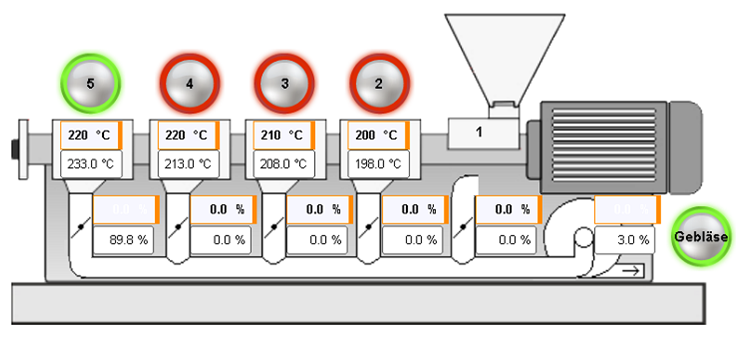
Heutige Extruder verfügen in der Regel über mehrere verschiedene Heiz- (bzw. Heiz/Kühl-)-Zonen, die individuell voneinander hinsichtlich der Soll-Temperatur parametriert werden können. Die Temperaturführung des Extruder ist wesentlich für die erreichbare Produktqualität sowie auch für die Produktivität der Anlage. Nichtsdestotrotz kommt es in der Praxis sehr oft vor, dass nicht optimale Temperaturvorgaben die Ursache für Probleme oder verminderte Produktivität sind.
Die Parametrierung der Zylindertemperaturen des Extruders wird in der Praxis meist auf der Basis einer Extruder- bzw. Prozesseinstellkarte oder einem Rezept (digitales oder analoges Rezept) vorgenommen, sobald ein neuer Prozess bzw. ein neues Produkt angefahren wird.
Typische Probleme die durch nicht optimale Zylindertemperturen entstehen können sind Inhomogenitäten in der Schmelze, Dimensionsprobleme am Produkt, Verzug, zu lange Kühlzeiten, geringer Durchsatz, Sagging, schwarze Stippen, Verbrennungen, Materialabbau, Verschlechterung der mechanischen Eigenschaften und viele weitere. Um derartige Probleme zu vermeiden ist es zusätzlich zur Initialparametrierung oft notwendig, während des laufenden Anlagenbetriebs die Zylindertemperaturen anzupassen, insbesondere dann wenn sich die Produktionssituation oder die Rahmenbedingungen geändert haben.
Beispielhafte Situationen bei denen eine Anpassung der Zylindertemperaturen oft zwingend notwendig werden sind:
- Änderungen am Rohstoff oder der
- Restfeuchte,
- Eingangstemperatur des Kunststoffes,
- Durchsatz, Schneckendrehzahl,
- Zusetzen von Filtern,
- Verschleiß an Schnecke oder Zylinder,
- Hallentemperaturen,
- etc.
Eine Anpassung der Zylindertemperaturen ist jedoch nicht nur beim Auftreten von tatsächlichen Produktfehlern sinnvoll. In sehr vielen Fällen ist das initial eingestellte Temperaturprofil zwar gerade ausreichend, aber keinesfalls optimal. In einem solchen Fall ließe sich durch eine gezielte Optimierung der Zonentemperaturen die Produktqualität steigern sowie die Robustheit des Prozesses oder sogar die Produktivität erhöhen.
Der Maschinenbediener besitzt zwar oft diese Freiheit (oder hat sogar die konkrete Aufgabe) das Zylindertemperaturprofil individuell während des Anlagenbetriebs zu Optimierungszwecken anzupassen, aufgrund der Tatsache, dass die Optimierung der Zonentemperatur aber sehr zeitaufwändig ist und nur mit einem gewissen Know-How bzw. Erfahrungsschatz zielführend durchgeführt werden kann, wird diese Optimierungsaufgabe oft etwas stiefmütterlich behandelt oder gar nicht durchgeführt. Insbesondere aufgrund der Tatsache, dass eine Verschlechterung der Parametrierung während eines laufenden Prozesses auch zur Produktion von Ausschuss führen kann, verringert (verständlicherweise) auch den Eifer des Maschinenbedieners zur Optimierung und führt zu eher vorsichtigen und zurückhaltenden Änderungen an der Anlage.
Grundsätzlich muss also unterschieden werden in die Initialparametrierung der Zonentemperaturen (z.B. beim Anfahren eines neuen Prozesses) sowie die Optimierungsparametrierung (während des laufenden Betriebs der Anlage).
Während die Initialparametrierung zwingend erforderlich ist und in den meisten Fällen auch einer vorgeschriebenen Prozesseinstellkarte oder einem Rezept entnommen werden kann, wird die Optimierungsparametrierung oft als Bonus (sozusagen Add-On) angesehen und daher oft vernachlässigt.
Zudem kommt es häufig vor, dass die Initialparametrierung (auch wenn diese irgendwann einmal sehr akribisch erarbeitet wurde) aufgrund nicht vorgenommener Änderungen oder Anpassungen am Rezept nicht mehr perfekt auf die tatsächliche Produktionssituation zutrifft. So entsteht eine Produktionssituation, die verborgene Potenziale beinhaltet.
Aber: Die optimale Einstellung der Zonentemperaturen ist aus verschiedenen Gründen kein trivialer Prozess, da:
- die Auswirkungen einer Temperaturänderung derart träge stattfindet, das oft kein eindeutiger Zusammenhang erkannt werden kann (viele Minuten bis hin in den Stundenbereich)
- die von den Zonenreglern angezeigten Temperaturen in der Regel nicht mit der tatsächlichen Schmelzetemperatur übereinstimmen, sondern (z.B.) stark abhängig sind von der Lage des Temperaturfühlers im Zylinder (der Maschinenbediener muss seine Anlage kennen)
- in aller Regel mindestens 3-4, teilweise aber auch bis zu 10 oder mehr verschiedene Zonen existieren, die sich gegenseitig durch Wärmetransportmechanismen beeinflussen (heute meist: ca. 4-6 Zonen)
- eine konkrete Zonen-Temperaturoptimierung somit zeit- (und kosten-)intensiv ist, weshalb derartige Optimierungsprozesse oft nicht gewollt sind und wodurch oft wenig Erfahrungsschatz hierzu vorhanden ist.
Initialparametrierung der Zonentemperaturen des Extruders:
Die typische Vorgehensweise bei der initialen Einstellung des Temperaturprofils basiert in der Regel auf verschiedenen materialspezifischen Kenngrößen sowie der Auswahl einer typischen Kennlinienform. Wichtige materialspezifische Werte sind die Erweichungstemperatur des Materials, die Glasübergangstemperatur (insbesondere bei amorphen Materialien), die Kristallisationstemperatur (bei teilkristallinen Materialien) sowie die Verarbeitungstemperatur. Aus diesen Werten lassen sich verschiedene Stützstellen ableiten, die dann je nach gewähltem Verlauf des Temperaturprofils ergänzt werden können.
Einzugszone
Als erstes betrachten wir die Temperatur der Einzugszone: In der Einzugszone (oft extern gekühlt, insbesondere Nutbuchse) ist es wichtig, dass der Kunststoff nicht anschmelzen kann, da ansonsten die Brückenbildung begünstigt bzw. das Zusetzen der Nutbuchse eintreten könnte. Zudem ist es die Aufgabe der Einzugszone die Luft aus dem Inneren des Extruders entweichen zu lassen. In dieser Luft können je nach verarbeitetem Material flüchtige Bestandteile enthalten sein, die bei zu kalten Temperaturen in der Einzugszone kondensieren und das Material kontaminieren könnten.
Aus vorgenannten Gründen wird hier somit eine Temperatur gewählt, die signifikant unterhalb der Erweichungstemperatur des Materials liegt. Typische Werte für die Einzugszone bei der Verarbeitung von Standard-Thermoplasten liegen bei 20°C-60°C, teilweise werden jedoch auch absichtlich höhere Temperaturen (60°C-95°C) eingestellt, insbesondere wenn die Drehmomentbelastung des Schneckenantriebes gesenkt werden oder der Anlagendurchsatz sehr hoch sein soll.
Zone 1
Die Parametrierung der 1. Zylinderzone hinter dem Einzugsbereich erfolgt nach folgenden Gesichtspunkten: Nach dem Einzug und fördern des Materials (Feststoffförderung) liegt die wesentliche Aufgabe des Extruders darin, das Material durch Reibung (Dissipation) aufzuschmelzen. Die eingestellte Temperatur sollte somit oberhalb der Erweichungstemperatur, bzw. sogar oberhalb der Kristallitschmelztemperatur des Materials liegen.
Damit gleichzeitig die zur Verfügung stehende Dissipationsleistung (Motorleistung) optimal genutzt werden kann, sollte dabei berücksichtigt werden, die Zone 1 so zu parametrieren, dass die Motorlast maximiert wird. Als Faustregel kann somit angewandt werden: Temperatur geringfügig oberhalb der Schmelzetemperatur, es sei denn die Motorleistung ist nicht ausreichend.
Zone 2 bis Zone “n-1”
Die Beschreibung zur Parametrierung der Zonen zwischen der ersten und der letzten Zone erfolgt weiter unten, da sich diese als Interpolation zwischen den zwei Stützstellen Zone 1 und Zone “n” ergibt.
Düse (Zone “n”)
Die Düsentemperatur entspricht in der Regel der Herstellervorgabe für die Verarbeitungstemperatur des Polymers, ist also die gewünschte Zieltemperatur welche am Ende des Extruders (bzw. des Werkzeuges) erreicht werden soll.
Ist eine Verarbeitungstemperatur nicht angegeben, trifft in vielen Fällen folgende Faustregel zu: Verarbeitungstemperatur von typischen teilkristallinen Werkstoffen: 50°C – 75°C oberhalb der Schmelztemperatur / Verarbeitungstemperatur von typischen amorphen Werkstoffen: 100°C oberhalb der Glasübergangstemperatur. (nach Dr. Chris Rauwendaal)
Achtung: Die eingestellte Temperatur entspricht in sehr vielen Fällen nicht der gewünschten Massetemperatur! Die reale Massetemperatur liegt in der Regel höher als die eingestellten Sollwerte. Eine absichtliche negative Korrektur kann somit in gewissen Fällen sinnvoll sein.
Zone 2 bis Zone “n-1”
Je nachdem welcher grundsätzliche Temperaturverlauf, siehe folgende Abbildung, gewählt wurde, werden die Temperaturen zwischen der ersten und der letzten Zone des Extruders, in der Regel mit möglichst gleichmäßigen Temperatursprüngen parametriert.
In den meisten Fällen, wird dabei einer der drei folgenden Verläufe für das Temperaturprofil gewählt.
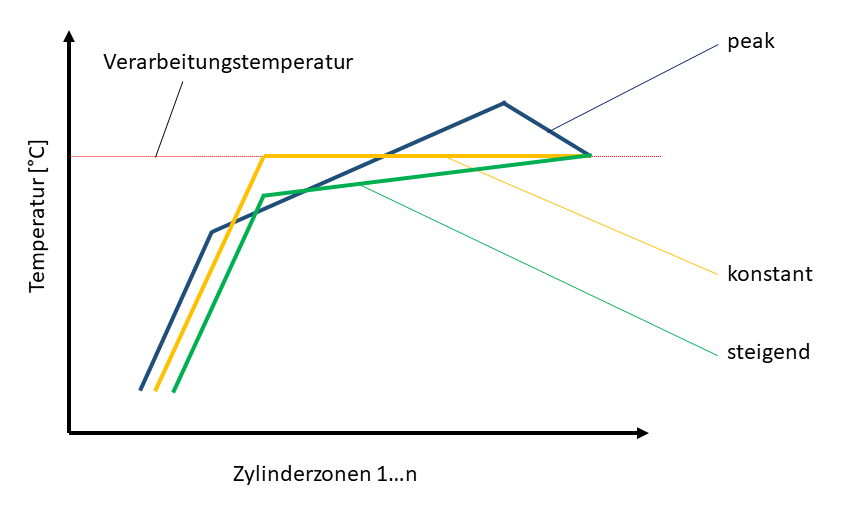
Steigendes Temperaturprofil: Beim steigenden Temperaturprofil wird ausgehend von der Temperatur der Zone 1 bis zur Zone “n” ein kontinuierlicher Temperaturanstieg eingestellt.
Konstantes Temperaturprofil: Beim konstanten Temperaturprofil wird (entweder beginnend bei Zone 1 oder bei Zone 2) eine konstante Zylindertemperatur über alle Zonen eingestellt, die in der Regel der Verarbeitungstemperatur entspricht.
Temperaturprofil mit Peak: Beim Temperaturprofil mit Peak wird zunächst ein steigendes Temperaturprofil eingestellt, welches seinen maximalen Wert auf einem Niveau oberhalb der Zieltemperatur einnimmt, dann aber zur letzten Zone hin abfällt und so die Zieltemperatur erreicht.
Die Aussage, welches der oben gezeigten Temperaturprofile das Optimale darstellt ist nicht allgemeingültig zu treffen und abhängig vom verarbeiteten Material, dem Extruder, dem Verschleiß des Systems sowie vielen weiteren Randbedingungen. Darüber hinaus ist die Temperaturführung des Extruders in der Praxis oft eine Art “persönliche Handschrift” des Maschinenbedieners/Produktionsbetriebes und Teil seiner individuellen “Produktionsphilosophie”.
Neben der initialen Auslegung der Temperaturführung nimmt die “Optimierung der Zylindertemperaturführung” (manuell und automatisch) einen immer größeren Stellenwert ein.
Hierzu existieren neben den manuellen Möglichkeiten heutzutage auch bereits Automatismen, die auf der Basis selbstlernender mathematischer Funktionen vollautomatisiert optimale Temperaturprofile identifizieren und autonom einstellen können.
Die grundlegende Herangehensweise der Temperaturoptimierung an Extruderzylindern wird in einem nachfolgenden Beitrag beschrieben. Dabei wird dann auch auf die grundlegenden Methoden und die Funktionsweise der Vollautomatischen Zonentemperatur Optimierung (ZTO) der SHS Extrudersteuerungen (Nachrüst-Steuerungen für existierende Maschinen, Retrofitting) sowie der virtuellen Assistenzsysteme der SHS plus GmbH (Feature-Erweiterung) eingegangen.
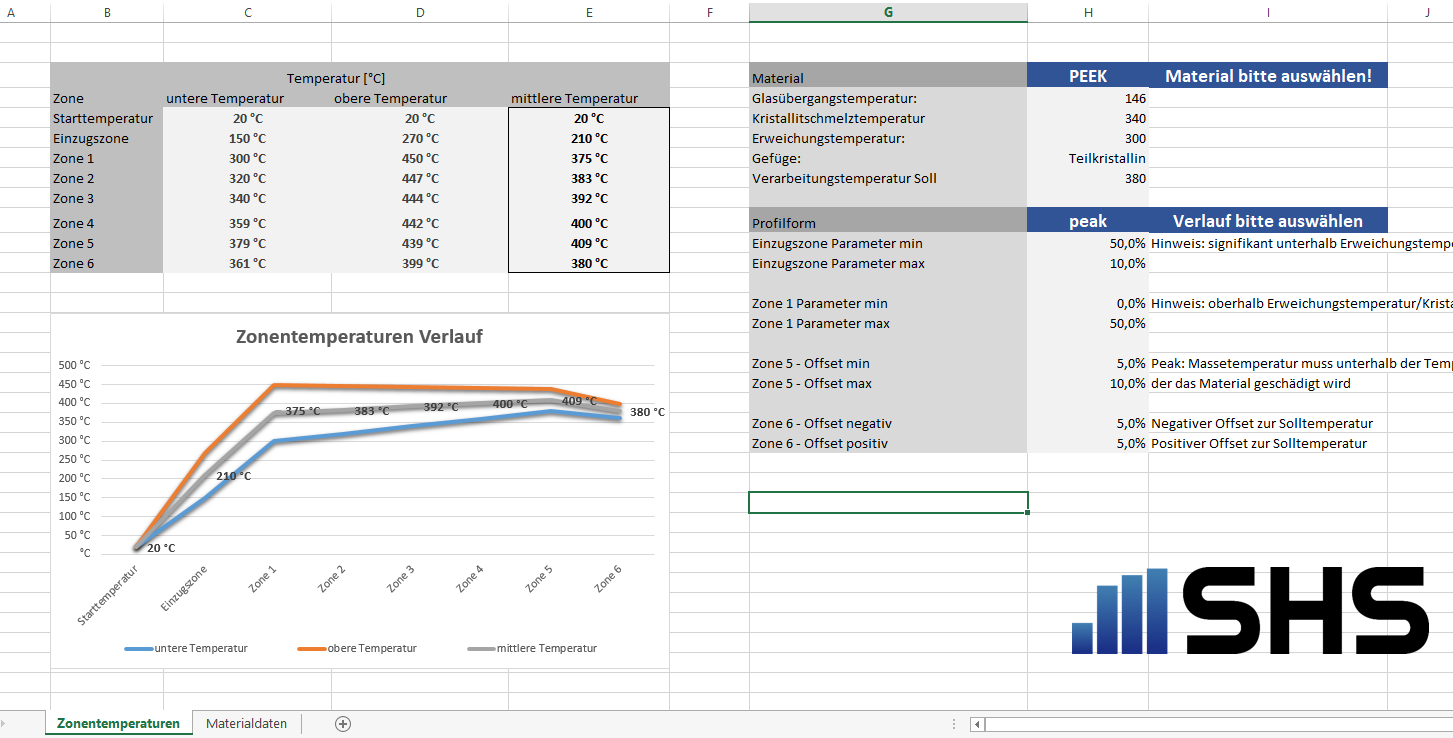
Melden Sie sich hier (kostenlos) als Premiummitglied an und erhalten Sie Zugang zu unserem Downloadbereich. Dort finden Sie unter anderem ein Excel-Berechnungsprogramm zur Auslegung des Temperaturprofils eines Extruders inkl. erweiterbarer Materialdatenbank. Zudem bleiben Sie als Premium-User stets informiert über neue Beiträge.
Today’s extruders usually have several different heating (or heating/cooling) zones, which can be individually parameterised with regard to the desired temperature. The temperature control of the extruder is essential for the achievable product quality as well as for the productivity of the plant. Nevertheless, in practice it happens very often that not optimal temperature specifications are the cause of problems or reduced productivity.
In practice, the cylinder temperatures of the extruder are usually parameterised on the basis of an extruder or process setting card or a recipe (digital or analog recipe) as soon as a new process or a new product is started up.
Typical problems that can result from non-optimal cylinder temperatures are inhomogeneities in the melt, dimensional problems with the product, distortion, too long cooling times, low throughput, sagging, black spots, black specs, material degradation, deterioration of mechanical properties and many others. In order to avoid such problems, in addition to initial parameterization, it is often necessary to adjust the cylinder temperatures while the system is running, especially if the production situation or the general conditions have changed.
Exemplary situations in which an adjustment of the cylinder temperatures is often absolutely necessary:
- Changes to the raw material or the
- Material moisture,
- Input temperature of the plastic,
- Throughput, screw speed,
- Clogging of filters,
- Wear on screw or barrel,
- Ambient temperatures,
- etc.
However, it does not only make sense to adjust the cylinder temperatures when actual product defects occur. In very many cases the initially set temperature profile is just sufficient, but by no means optimal. In such a case, targeted optimization of zone temperatures could increase product quality and increase process robustness or even productivity.
The machine operator often has this freedom (or even the specific task) to adjust the cylinder temperature profile individually during system operation for optimization purposes, but due to the fact that the optimization of the zone temperature is very time-consuming and can only be carried out with a certain amount of know-how or experience, this optimization task is often neglected or not carried out at all. Especially due to the fact that a deterioration of the parameterization during an ongoing process can also lead to the production of waste materials, also reduces (understandably) the zeal of the machine operator for optimization and leads to rather cautious and restrained changes to the plant.
Basically, a distinction must be made between the initial parameterization of the zone temperatures (e.g. when starting a new process) and the optimization parameterization (while the system is running).
While the initial parameterization is absolutely necessary and in most cases can also be taken from a prescribed process control card or a recipe, the optimization parameterization is often regarded as a bonus (so to speak add-on) and therefore often neglected.
In addition, it often happens that the initial parameterization (even if it was meticulously worked out at some point) no longer perfectly matches the actual production situation due to changes or adjustments not being made to the recipe. This creates a production situation that contains hidden potentials.
But: For various reasons, the optimal setting of zone temperatures is not a trivial process, since:
- the effects of a temperature change are so slow that often no clear correlation can be recognized (many minutes up to the hour range)
- the temperatures displayed by the zone controllers do not usually correspond to the actual melt temperature, but (e.g.) are strongly dependent on the position of the temperature sensor in the cylinder (the machine operator must know his system)
- there are usually at least 3-4, but sometimes up to 10 or more different zones, which influence each other through heat transport mechanisms (today mostly: approx. 4-6 zones)
- a concrete zone temperature optimization is therefore time (and cost) intensive, which is why such optimization processes are often not wanted and why often little experience is available.
Initial parameterization of the zone temperatures of the extruder:
The typical procedure for the initial setting of the temperature profile is usually based on various material-specific parameters and the selection of a typical characteristic curve shape. Important material-specific values are the softening temperature of the material, the glass transition temperature (especially for amorphous materials), the crystallization temperature (for semi-crystalline materials) and the processing temperature. These values can be used to derive various sampling points, which can then be supplemented depending on the selected course of the temperature profile.
Feed zone
First we consider the temperature of the feed zone: In the feed zone (often externally cooled, especially the grooved barrel) it is important that the plastic cannot melt, otherwise bridging may occur or the grooved barrel may become clogged. In addition, it is the task of the feed zone to let the air escape from the inside of the extruder. Depending on the material being processed, this air may contain volatile components which could condense and contaminate the material if the temperatures in the feed zone are too cold.
For the above-mentioned reasons, a temperature that is significantly below the softening temperature of the material is selected here. Typical values for the feed zone during the processing of standard thermoplastics are 20°C-60°C. However, higher temperatures (60°C-95°C) are sometimes deliberately set, especially if the torque load of the screw drive is to be reduced or the plant throughput is to be very high.
Zone 1
The parameterization of the 1st cylinder zone behind the feed area is carried out according to the following aspects: After feeding and conveying the material (solids transport), the main task of the extruder is to melt the material by friction (dissipation). The set temperature should therefore be above the softening temperature or even above the crystalline melting temperature of the material.
In order to make optimum use of the dissipation power (motor power) available at the same time, Zone 1 should be parameterised in such a way that the motor load is maximised. As a rule of thumb, it can therefore be applied: Temperature slightly above the melt temperature, unless the motor power is insufficient.
Zone 2 to zone “n-1
The description of the parameterization of the zones between the first and the last zone is given below, as this results in interpolation between the two grid points zone 1 and zone “n”.
Nozzle (Zone “n”)
The die temperature usually corresponds to the manufacturer’s specifications for the processing temperature of the polymer, i.e. the desired target temperature to be reached at the end of the extruder (or die).
If a processing temperature is not specified, the following rule of thumb applies in many cases: Processing temperature of typical semi-crystalline materials: 50°C – 75°C above the melting temperature / processing temperature of typical amorphous materials: 100°C above the glass transition temperature. (after Dr. Chris Rauwendaal)
Attention: The set temperature does not correspond to the desired melt temperature in very many cases! The real mass temperature is usually higher than the adjusted set points. An intentional negative correction can therefore be useful in certain cases.
Zone 2 to zone “n-1
Depending on the basic temperature curve selected (see following figure), the temperatures between the first and the last zone of the extruder are usually parameterised with as uniform temperature jumps as possible.
In most cases, one of the following three courses is selected for the temperature profile.
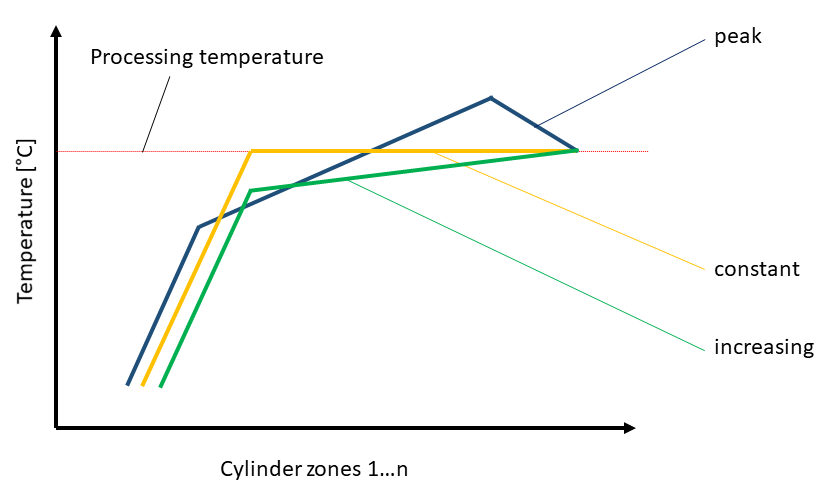
Rising temperature profile: As the temperature profile rises, a continuous temperature increase is set from the temperature of zone 1 to zone “n”.
Constant temperature profile: With the constant temperature profile, a constant cylinder temperature is set (either starting at zone 1 or zone 2) over all zones, which generally corresponds to the processing temperature.
Temperature profile with peak: For the temperature profile with peak, a rising temperature profile is set first, which takes its maximum value at a level above the target temperature, but then drops towards the last zone and thus reaches the target temperature.
The statement as to which of the temperature profiles shown above represents the optimum is not generally valid and depends on the processed material, the extruder, the wear of the system and many other boundary conditions. In addition, the temperature control of the extruder in practice is often a kind of “personal signature” of the machine operator/production company and part of its individual “production philosophy”.
In addition to the initial design of the temperature control, the “optimisation of the cylinder temperature control” (manual and automatic) is becoming increasingly important.
For this purpose, in addition to the manual possibilities, automatisms already exist today which, on the basis of self-learning mathematical functions, can automatically identify and autonomously set optimal temperature profiles.
The basic approach of temperature optimization at extruder cylinders is described in a following article. The basic methods and functions of the fully automatic zone temperature optimization (ZTO) of SHS extruder controls (for retrofitting on existing machines) and the virtual assistance systems of SHS will also be discussed there.
Register here (free) as a premium member and get access to our download area. There you will find, among other things, an Excel calculation program for designing the temperature profile of an extruder including an expandable material database. In addition, as a premium user you will always be informed about new contributions.